|
|||||||||||||||||
|---|---|---|---|---|---|---|---|---|---|---|---|---|---|---|---|---|---|
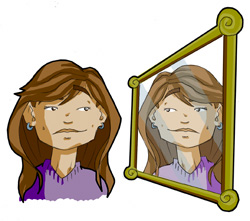
Self observation brings man to the realization of the necessity of self change. And in observing himself a man notices that self observation itself brings about certain changes in his inner processes. He begins to understand that self observation is an instrument of self change, a means of awakening. George Gurdjieff The True Self The image that you see in the mirror is not you, it is your body. It is the magnificent vessel that you occupy as a human being. This is the instrument that you use to observe, navigate and interact with the outer world but it is not you. Now, focus your attention on your thoughts. The chatter that you hear in your mind is not you either. It is the activity of your conscious mind, the voice of your ego. These messages are a reflection of your current self image and are not necessarily in your best interest. Quiet the voice of your ego and observe your feelings. What you feel is a communication from your subconscious mind and represents your current reaction to your environment.
|
 |
||||||||||||||||
You are that which is observing your thoughts and feelings. You are an intelligence, a form of pure energy. This is your true self and the center of your inner world. You are an extension of the infinite intelligence of the universe that you may refer to as God, Buddha, Higher Self, or the Divine. You are by design kind, nurturing and loving, a focal point for the creative intelligence of the universe. Intuition is your source of true inspiration, enthusiasm, and motivation. You must however be aware of your true essence before you can fully experience the abundant life that is your birth right. This awareness is known through a higher consciousness. Through higher consciousness you gain control over your ego and the outer world by living in harmony with our world. The true self is our spiritual essence or energy. It is the transcendent, perfect, unchanging part of ourselves. When, through higher consciousness, we encounter our true self, we re-evaluate the ego. In our meeting with the true self, we retain the sense of the ego as a still valid part of ourselves. The ego is no longer our only center of identity and its importance downsizes to being simply one element of many in the psyche, still powerful and important as a "manager", but it is not in control. Understanding your true self on an intellectual level does not in itself produce results. You must internalize this knowledge and apply it in your life for it to become the guiding wisdom that transforms your reality. Your company and our world is a collection of individuals urged on by the loving presence within. The whole behaves precisely as its individual parts. When you make the shift in consciousness you are contributing to the transformation of our world. The true self grants new perspectives. When we look at the ego from the viewpoint of the true self, we gain an objective understanding of the nature of the ego. When we meet the true self, we realize that we have previously assigned some of the true self's functions to the ego simply because we did not know the true self, and the ego seemed to be the only part of us that could fill these roles. Now we can transfer some of the ego's functions to the true self. Instead of allowing the ego to devise our goals, we accept the true self's goals, that are aligned toward the actualization of its life purpose. The ego, without the wise, balancing influence of the true self, tends to select goals that are no more than ego symbols. -A deeper understanding of the components of the psyche, because the true self has an overview of the psyche. Our true self's perspective is free from the ego's distortions. We can not know the true self intellectually. Even though we can make certain observations about the true self, we can not study the true self in the same manner that a scientist would examine an amoeba under a microscope. The true self is the essence of us, therefore any viewpoint such as the ego's viewpoint of the true self, would have a limiting blind spot, as in the situation of an eyeball trying to look at itself. We would be separating ourselves as "observer" and "observed" when in fact the true self is both. Intellectually the true self is a construct that serves to express an unknowable essence that we cannot grasp as such, since by definition it transcends our powers of comprehension. We can meet the true self in other ways. To the extent that the true self is comprehensible, we become familiar with it through the sheer experience of it. Until we discover our true self, we often project it onto people who exhibit spiritual qualities such as a therapist, pastor, or a dear friend, or we may project it upon an object such as a crucifix, or a place such as a church, or an organization such as a charity. We truly become acquainted with our true self as we develop a higher consciousness. Life is a cycle. We need to concentrate on the development of the ego and its external manifestations such as our place in the world, our persona, or our differentiation from other people. We then turn to the next task in the cycle of life, to reintegrate that which we needed to separate out during the ego building stage. As we become familiar with the various parts of ourselves, we gain a view of the totality of ourselves, we awaken to the synergism of these parts. They are not just separate elements, but they are also part of an overall system that has a higher consciousness of its own. There comes that mysterious meeting in life when someone acknowledges who we are and what we can be, igniting the circuits of our highest potential. Rusty Berkus Next topic: Oneness |
|||||||||||||||||
The sixteen topics in the Self Awareness section are:
|
|
||||||||||||||||